How Smart Leaders Buy AI Engineering. The "AI Discount" Trap. The Hidden Math Behind the AI Discount.
The "AI Discount" Trap
Clients are demanding discounts because we use AI in software development. Let’s actually calculate what this "cheap AI" costs.
The IT industry has quietly entered a new era: the age of AI-native engineering. While the benefits are obvious, software agencies now face a universal headache.
Almost every client asks for an “AI discount” or pushes budgets down, claiming:
“AI does all the heavy tasks now anyway, right? You’re just pressing buttons.”
Hardly anyone understands what they are actually asking us to cut.
Everywhere you look, young “vibe-coders” promise the moon:
“We’ll build you an enterprise-grade system in 3 days using AI!”
Everyone rushes in. Everyone vibe-codes. And in meeting rooms, the exact same question echoes:
“If you’re using AI, why am I paying the same rate as last year? Where’s my discount?”
It sounds logical on the surface. In practice? It’s one of the most expensive mistakes a business owner can make in 2026.
Where does this logic come from?
A client sees a 30-second demo where a chatbot generates a signup form and draws a simple conclusion: Better tools = lower bill.
In a single month, clients are already getting significantly higher output than they did a year ago. That speed boost is the free bonus of technological progress.
When clients ask for a discount on top of that, they are asking to cut the invisible work: Code verification.
While AI generates code instantly, that code still needs to be:
Correct
Scalable
Secure
Reliable
Discount logic made sense in an era where the main bottleneck was typing code.
That era no longer exists.
The Hidden Math Behind the AI Discount
"If output jumped by 24% for the same budget, shouldn’t we get a discount?"
Where would that price cut actually come from? The engineering effort didn't vanish; it shifted.
Let’s look at a realistic scenario: A team of 6 engineers spending 1,000 hours per month.
Pre-AI Era:
Average feature time: 20 hours (14h coding + 4h testing + 2h code review)
Monthly Output: 50 fully tested features (300 total hours spent on verification)
AI Era:
AI cuts coding time from 14 hours down to 10.
Testing (4h) and Code Review (2h) do not shrink. AI-generated code poses equal, if not higher, architectural and security risks, requiring strict human verification.
New feature time: 10h + 4h + 2h = 16 hours
Monthly Output: 62 features (372 total hours spent on verification)
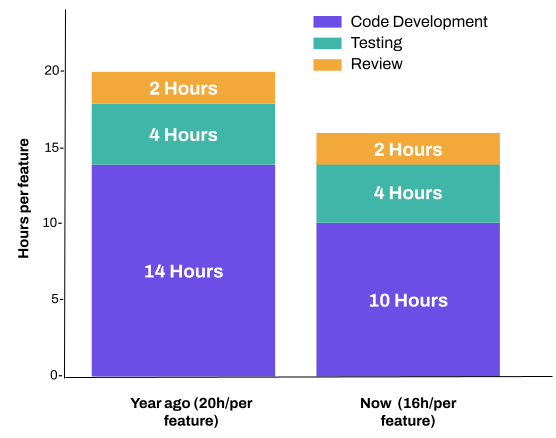
That’s an extra 72 hours of intense verification work per month, nearly two full workweeks for a senior engineer, absorbed within the exact same 1,000-hour team cap.
When a client insists on a 20–30% discount, there is only one place left to cut: verification time.
Here is what happens in two different scenarios with the same 1,000-hour budget:
Scenario A (Maintain Standards): The team keeps 6 hours of verification per feature. You get 62 battle-tested features, each line of code verified by a human expert.
Scenario B (Demand the Discount): Verification is cut to 3 hours per feature. 10 to 12 features every month pass with superficial testing.
In 6 months, you have 70+ unverified features running in production, built on code nobody fully understands because "AI generated it and it compiled."
When half of those features break down the road, fixing them costs an entire month of full-team labor.
The discount vanished. It just returned later under a new name: Unplanned System Re-engineering.
How Smart Leaders Buy AI Engineering
A Padawan types faster and looks flashier than a Master. But speed without deep mastery is a structural hazard.
True engineering strength in the AI era isn't about code generation speed; it's about accountability. It’s about understanding architecture, managing risks, and ensuring that a growing codebase doesn't turn into toxic tech debt.
Instead of asking your dev team for a generic "AI discount," ask them these 4 questions:
How is generated code verified before hitting production?
Does your review process scale alongside generation volume?
Can your team explain the structural logic behind key architectural decisions?
What happens to this codebase in 12 months when we need to adapt it, not rewrite it?
If a vendor can’t answer these four questions clearly, any discount they offer is an expensive illusion. You pay less today; you pay double tomorrow.
Selling dev hours is dying because an hour is no longer an accurate measure of value.
The real question business leaders are asking today:
“What specific outcomes am I paying for, who guarantees quality, and how is the result verified? How many hours you spend is no longer my priority.”
In upcoming articles, I’ll share a concrete, math-backed framework for evaluating the value of software development, so both clients and vendors can use the same metrics instead of arguing over untrusted hourly rates.
Stop paying for the illusion of speed. Start asking what you’re actually buying.
How is your organization adapting software vendor evaluations in the AI era? Let’s discuss.
Please contact me through the SOFYCOD corporate website, and I will be happy to consult with you and help with right pathway.